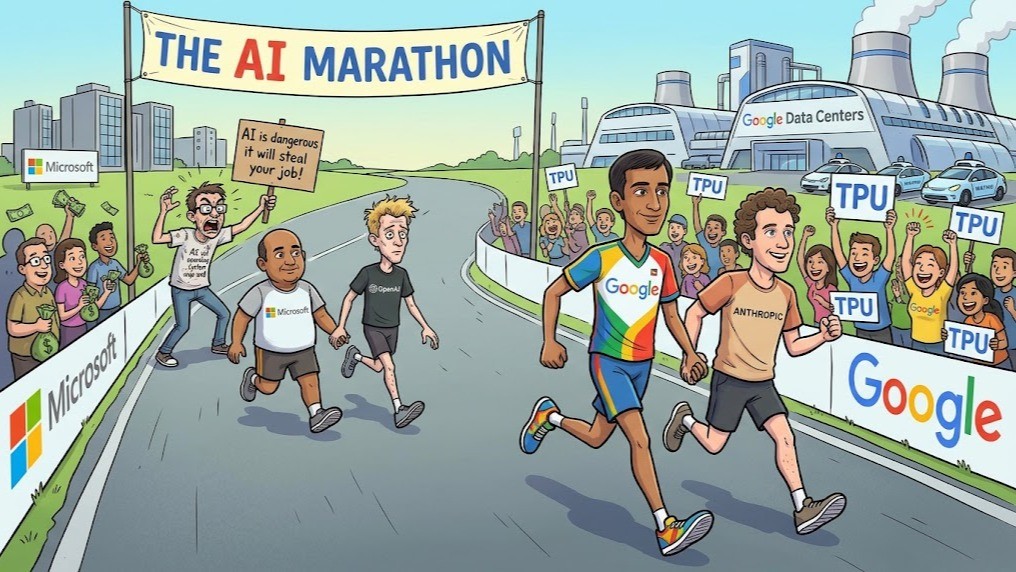
The most frequent subjects nowadays are: (1) AI companies missing earnings; (2) AI companies failing to rate well for an IPO.
These are interesting subjects, but in my mind, these are the most important points: 1. AI has become essential to everyone; 2. Who is going to win the AI race, and provide AI to the most people? Many AI companies understand this, and it is part of the reason why they want to embed AI in all their products, it is the glue which helps selling everything else. After all, who wants a dumb, non AI text editor, email system, etc? And this is part of the reason why some of the AI companies who can stretch into negative cashflow (Alphabet) and issue bonds. More about it soon.
Is this question of “Who is going to win the AI race” valid? Absolutely. I remember that during the '80s and '90s, we could buy spreadsheet software for investment calculations or accounting from IBM (Lotus 1-2-3), from Borland (Quattro Pro), or from Microsoft (Excel). Today, the market is surely dominated by Excel, though there are newcomers like Google Sheets. IBM stopped selling its spreadsheet software Lotus 1-2-3 in 2013.
At the bottom of this post you have the chart overlaying an investment of 1 dollar in IBM and one dollar in Microsoft in the 1990s. The chart simulates the dividends are reinvested in the stock that paid them. It was a bet on who was going to become the king of spreadsheets (and Operating systems). It was not a bet on who would miss earnings or not. Perhaps you missed earnings because you were focused on growing sales.
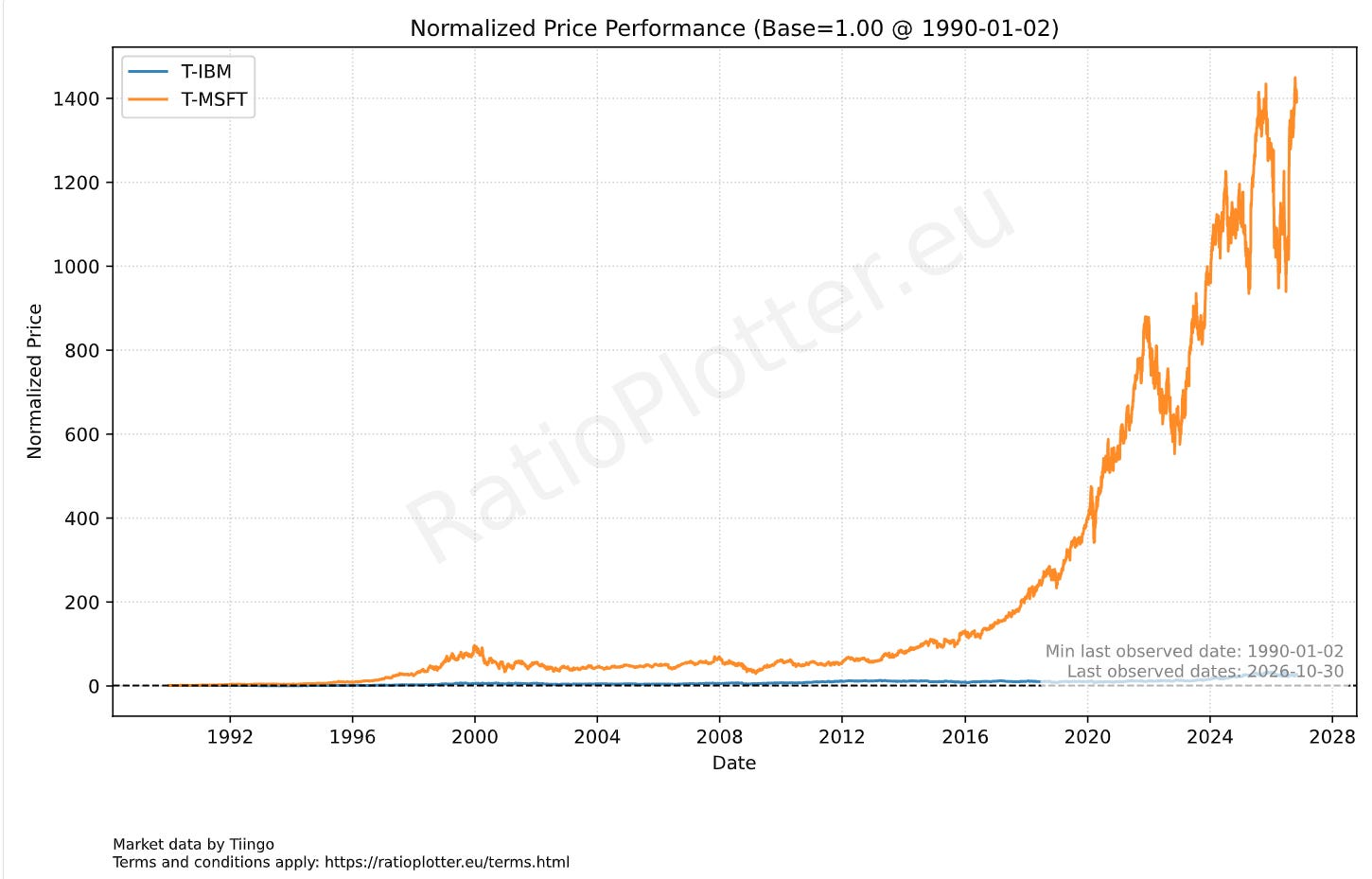
One dollar invested in Microsoft in the 90's against one dollar invested in IBM in the 90's. The chart simulates the dividends are reinvested in the stock that paid them.
What is my point? Well, during the '80s and '90s, sales (or earnings) of spreadsheet licenses for accounting departments were something really, really sexy. Spreadsheets are no longer sexy. They went from star product to perhaps cash cow as the ERPs, and then the cloud came along. And while the earnings from that time did matter, what matters much more now is who dominated the market for spreadsheets and sold the most spreadsheet licenses over the last few decades. Also, who got the most share of wallet by selling most ancillary products to spreadsheets during the 90’s. The answer, without a doubt, is Microsoft.
The moat was built by dumping the competitors and not by making something others could not do also. As products grow in complexity the game becomes for just a few… Take AI complexity: only a few companies have the chips, data-centers and services to bundle AI with. And yet there is so much competition.
You may say that soon a good enough AI will run in your laptop. Good enough and integrated with your mail, Google drive, driverless car, Google maps? Find an AI that is good enough that can run in your laptop even if not integrated. And we will find an AI ten times better and bigger one that requires a data center to run. People on the edge (research) need maximum intelligence.
As for the AI race, who is going to win? The company that will win the AI race is the one best equipped to undercut and outpace nearly all the others, and the company with the fewest chokepoints in delivering AI. It is not the one that is not missing earnings today. You don’t run a marathon showing you can sprint at the start. Sundar Pichai, CEO from Alphabet said the AI race was a Marathon. Who has the best capacity to outcompete and run the 42km of the marathon while others abandon race before for being tired? The marathon winner will be the company with the most sales revenue; the company with the most vertical integration—from chip design, to having its own GPU/TPU, to having its own cloud data center, to having user-facing services with AI embedded. That company right now is by far Google. Yet, it has been penalized for missing earnings, even though it is likely to be the king later. Sacrifice a pawn for a cheque mate on the opponent.
Why the rush for earnings? Investors are told to think long term. If you want earnings you should have bought a dividend company, not a growth one. Right now I see a game of borrowing to grow into a space and price out competitors. I did not choose that game; they chose it, and they understand that this is the game to be played. Let it miss earnings to gain future sales by outperforming the others.
Does this mean I am buying Google now that it is down? No, I bought it ages ago at different times and I have Alphabet positions at 200% profit, 300% profit and so on. I do not even look at them. I just need to sit and wait—I can even take a Lombard loan against that valuation to buy something else while it's cheap.
Just to compare the first metric that makes a marathon winner: Google's yearly revenue is $402.5 billion, Microsoft's is $331.84 billion, and Meta's is $200 billion. Meta is half the size of Google; it tries to offer open-source AI mixed with paid AI to erode new revenues from Google who only offers paid AI. It is their way of dumping. The way of the giant to dump is offer better products at a good enough price. To create leading edge AI for research (Alpha fold).
If you buy a spreadsheet alone without a word processing package, mayeb it is okay. Would you buy AI alone? Would you buy an AI that does not talk to the world? Would you buy an AI that does not speak to your Gmail? To your Google Drive? To your Google Maps? To your Google Photos? To your Google Wallet? To your Waymo self driving car? An AI that does not remember your questions, does not know you very well? You see my point?
Microsoft was, for a long time a company focused on selling licenses, that is still largely the case. Amazon is a company that focuses on renting machines in its cloud. At Amazon cloud you can even rent an EC2 machine where you install a Microsoft database license. The Microsoft license can be bought right there inside AWS Cloud.
How about Google and Google cloud? It is not a focus on selling licenses, neither a focus on renting machines. It is a focus on services. Services is what Generation Z wants. They do not want to own a car (license it), they do not want to rent a car, they want Waymo or Uber car services. They do not even want to know what a spark plug is. Let the service company handle it. They want reliable, cheap services when they need. Also perhaps because many of them cannot afford a car. The main reasons why people buy something are: (1) It solves a problem (the more problems it solves the better); (2) It is easy to use (seamless integration with other services); (3) It provides a good experience.
Claude’s largest customer base are programmers. Does it solve everybody’s problem around say Google Drive, Google Sheets?
I welcome the discussion. I do not think AI is a product that you can sell as the main product unless it is for a research institute using it to design new proteins or new materials. Even then it may be integrated with a proprietary self-learning lab after all, what use is a brain without a body?
The criteria for selling is different when they sell AI products not for high tech labs, but for mere mortals like most of us. We are buying AI to automate a valuation process or to write a contract in Google Docs by consulting other previous contracts in Google Docs.
Anyway, just my two cents. It is not why we are here for. We are here for the analytics, for the charts. But I had to say this and show it also with a chart of what happened to IBM and what happened to Microsoft. And Microsoft had less sales at the start than IBM, but a better product suite with the OS.
Are there contingencies and suprises to this race? Absolutely: someone who creates a GPU that runs on photonics and is much better than NVIDIA's will disrupt this. It will probably be easily assimilated by front-runners of the race.
Final disclaimer: This article is for informational and educational purposes only and does not constitute financial, investment, or trading advice. Past performance and statistical metrics do not guarantee future results. Always conduct your own due diligence or consult with a qualified financial advisor before making any investment decisions.