Is Microsoft Losing Its Competitive Edge to Alphabet?
Recent moves by fund managers to trim their Microsoft holdings, combined with a friend's complete transition to Alphabet/Google's service-driven ecosystem (Pixel, Gemini, Drive, Books), prompted me to run a quick comparative analysis of both companies. I’d appreciate if others would contribute to the analysis.
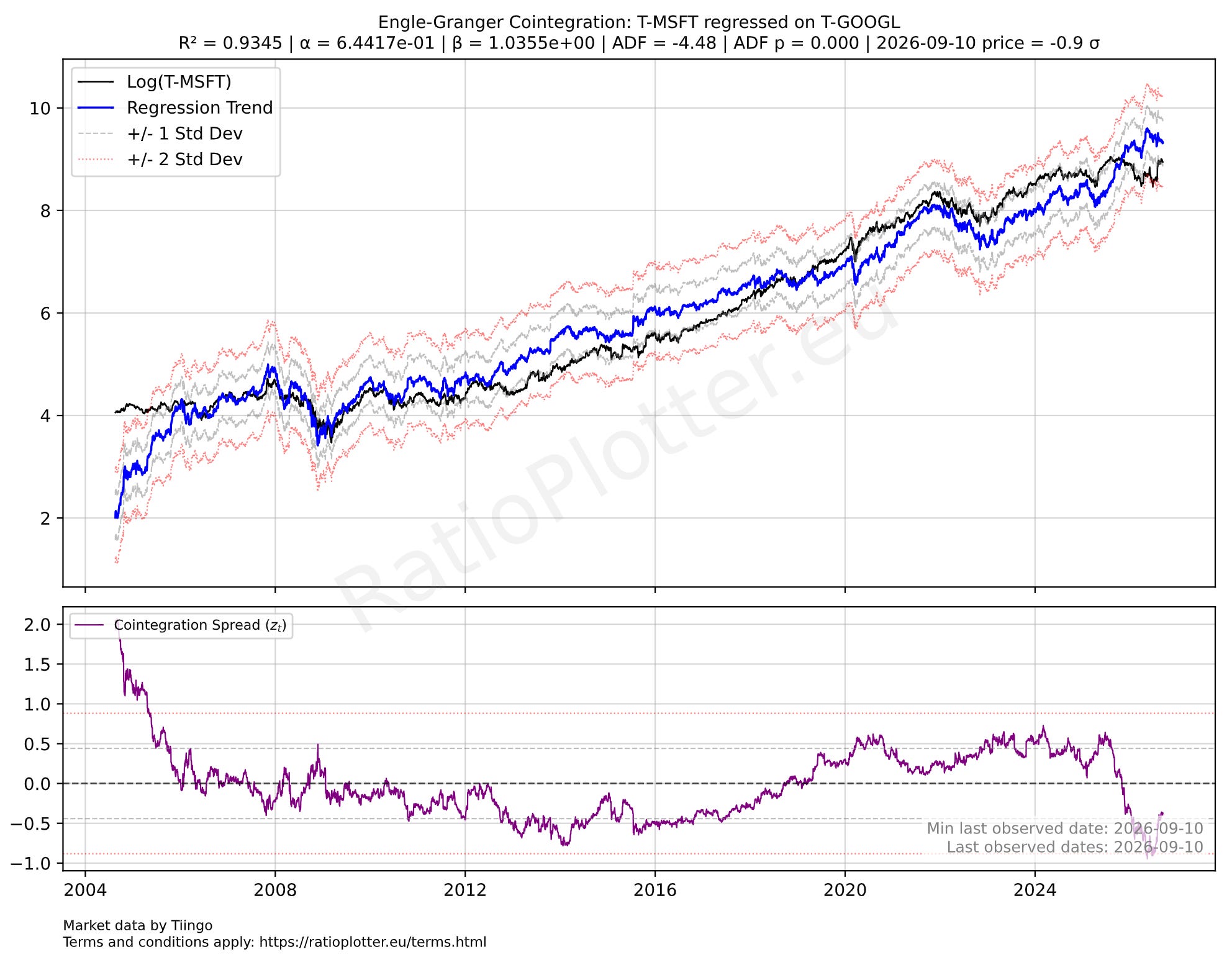
First I ran an Engle Granger Cointegration model on the stock prices of Microsoft and Alphabet (first chart). This is an analysis typically done for competing companies, companies that share the same drivers. Don’t worry, I will explain what it means.
Pay attention to how the black line crosses down on the blue line since about year 2025 (AI). The black line is the actual price of Microsoft. The blue line is the Microsoft price predicted by the model, which is trained to infer it just by looking at the price of Google.
So what does this chart mean? It means you could train a model to predict Microsoft prices just by feeding it the Google stock price. The model would track the price of Microsoft almost with perfection (the statisticians here would agree with me, I save you from details). Now that model is failing and the Microsoft price has touched -2 standard deviations below what the model says it should be.
One is then left with the question: is the model rotting? Or is Microsoft losing its decade long competitive status against Alphabet?
To investigate the above I decided simply to plot the ratio of Microsoft’s revenue to Alphabet’s revenue. I let the chart speak for itself (second chart). Actually, I explain it and peer into the cause. Microsoft total revenue started at 95% of what Alphabet’s was, it has recently touched 70%. Both are growing, Microsoft is needing to sell more licenses to catch-up. Alphabet seems to be providing a lot of services and is able to charge a decent total revenue for those services.
If I remember history, Microsoft is that company that invented the Java alternative that did not catch; it invented the Encarta Encyclopedia that got substituted by the Wikipedia; it created the second best search engine that has a fraction of the users; it created the Office package that charges you 100s even if you just write one document an year; it fought the early browser wars and now has the browser that I forgot the name (maybe I should have uninstalled it); and finally it recently got reprimanded by the DoD for having too many security vulnerabilities.
Companies can easily forget that revenue comes from serving the customer and not themselves. Let’s hope that Google stays true to its lemma: “don’t be evil” before, like every great power, it gets too big and corrupts. So far Alphabet is giving a lot to science and humanity like the Alpha Fold project, and of course… it is taking its fair share in revenue, or perhaps being awarded that by the customer.
The world needed some healthy competition. Will Microsoft learn its lesson and turn around? It has recently changed how it reports revenues by bundling different product lines together in a different way. Is it all smoke and mirrors? It cannot really hide the bottom line (second chart).

Subscribers can access the latest: Engle Granger Cointegration Model on MSFT and GOOGL.