Ticker Correlation Matrix
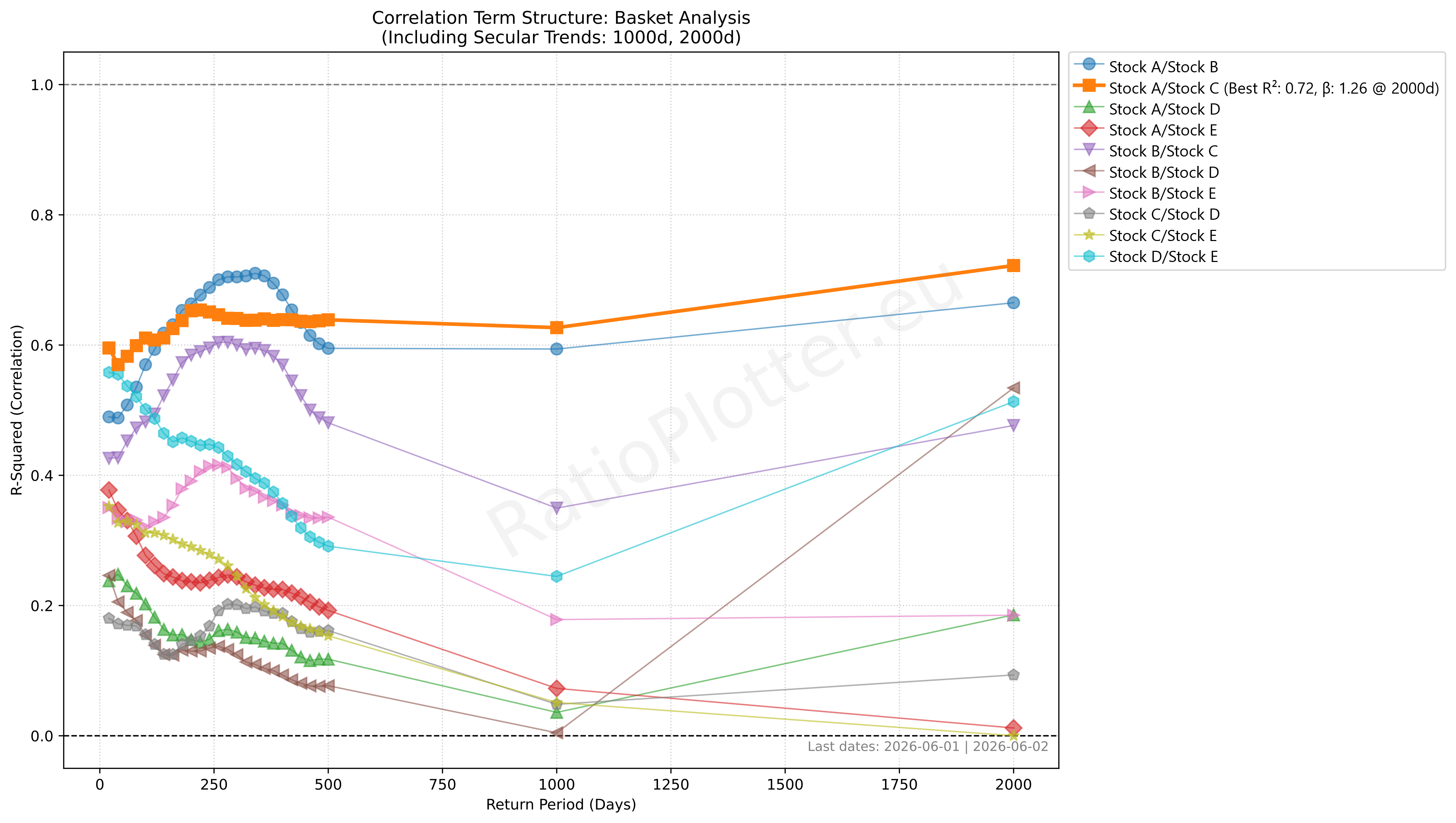
Enter 2 to 5 tickers to generate a pairwise R2 correlation matrix. For the best correlations see: correlation insights.
Popular Baskets
R2 and Beta
This tool calculates the R2 between every pair of assets in the given basket. While R2 measures the strength of the relationship, Beta is provided for the strongest correlations to indicate price sensitivity.
The movements of these assets are largely independent. Low R2 values indicate that one asset's returns do not explain the other's, making them ideal for broad portfolio diversification.
The assets show a partial statistical connection. This range suggests a "weak link" where trends may occasionally align, but the relationship is not reliable enough for precise mean reversion or tight hedging.
These assets are highly correlated. A high R2 indicates that the returns of one asset are a strong predictor of the other. These pairs are optimal for mean reversion trading and highly effective hedging strategies.
Ticker Data Usage and Sourcing
Ticker Data Sources
RAT() Ticker function
LAG() Ticker function
MATH- Tickers
CURVE_FROM_VECTOR()
CURVE_FROM_VECTOR([198.27, 211.92, 245.12, 281.72, 318.27], '2026-06-30', 'last', '1y', 'linear', 'forward_fill')
The first argument is the time ordered list of data points, separated by commas. The second argument ('2026-06-30') is the one data anchor we need to plot these values over time.
The third argument ('last') tells the system to apply the anchor date to the last value, another value for this parameter is 'first'.
The '1y' tells the values fall on the exact same date on each year (or closest if leap year).
The '1y' could also be '1q' or '1m' for quarter or month. The same considerations made for year apply.
The 'linear' parameter tells the system how to interpolate the values for days in between the value data points given, another possible value here is 'forward_fill'.
The 'forward_fill' last parameter is about the extrapolation, its possible values are: 'none', 'forward_fill', 'linear'.
Default Ticker Column Projections & Adjustments
Plotting Dividends Reinvested at Your Portfolio Return Rate
This is a function available only for users with the advanced subscription. The first argument is the Ticker simulated, the second is your portfolio CAGR rate (in this case 0.25 = 25% yoy). We apply the daily equivalent rate though. The third argument is the initial investment in the currency of the stock ticker. The last argument is the start date. For a full example see our article on dividend reinvestment simulation or our article looking back at Warren Buffet's investment in Coca-Cola and the results of its juicy dividends.
Calculating slope, velocity, or derivating (these are all synonyms)
Z scaling, bringing data to the normal curve Z score scale, normalizing
This is a function available only for users with the advanced subscription. The single argument can be a Ticker or another vector function. For a full example see our macro quadrant plot.